Kareem Abdul-Jabbar
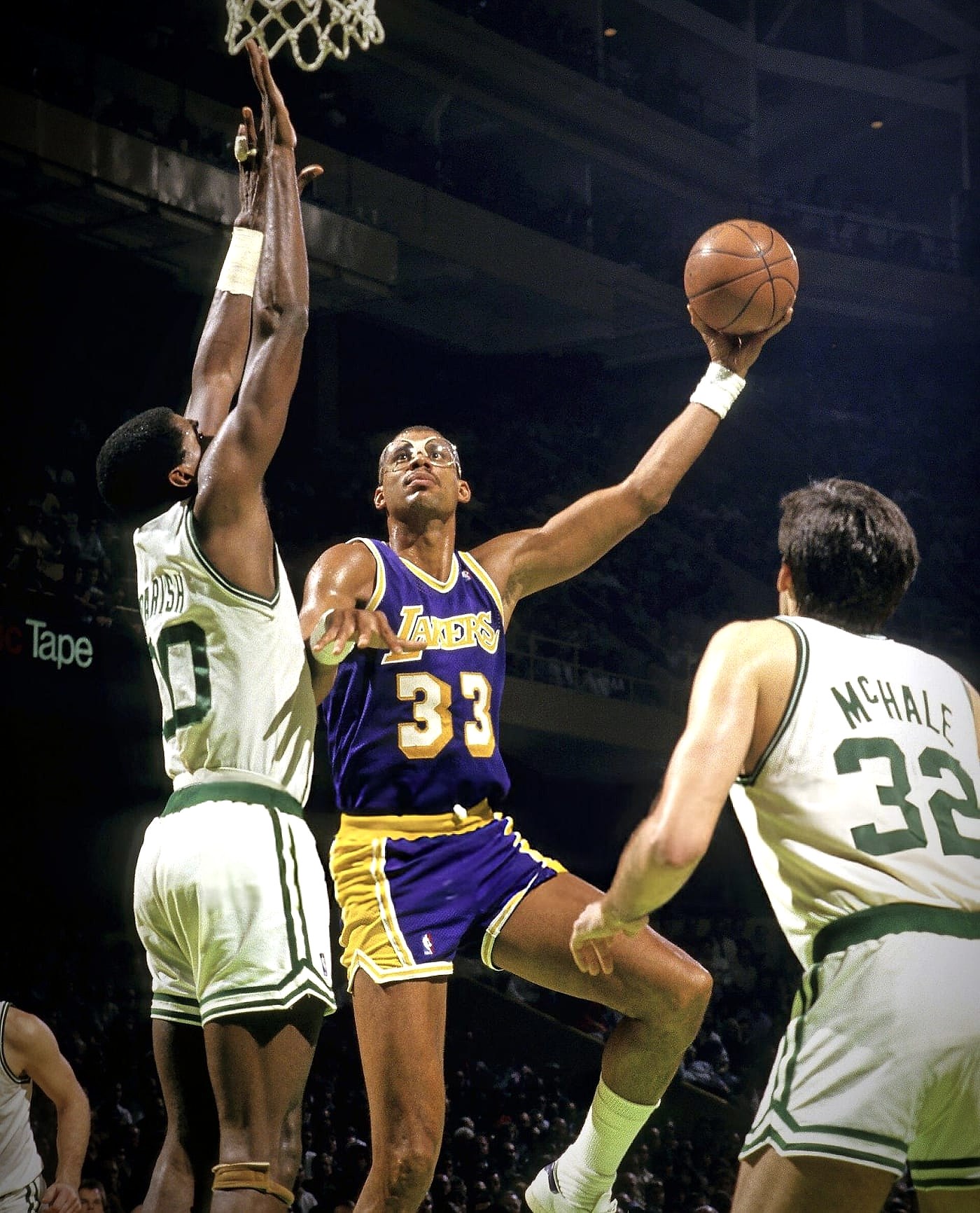
Kareem Abdul-Jabbar played twenty NBA seasons, scored 38,387 points, and won six championships and six regular-season Most Valuable Player awards, which is still more MVPs than anyone else has won. He held the league’s career scoring record for thirty-eight years and ten months, from April 1984 until LeBron James passed him on February 7, 2023.
He is also the only player in American basketball with a shot named after him that nobody has been able to copy, and the only one the NCAA rewrote its rulebook to slow down.
Harlem, Power Memorial, and a seventy-one-game winning streak
He was born Ferdinand Lewis Alcindor Jr. on April 16, 1947, at Harlem Hospital. His father, Ferdinand Sr., worked as a New York Transit Authority police lieutenant and studied trombone at Juilliard. By nine, the son was 5 feet 8. By fourteen he was 6 feet 8.
Shop Kareem Abdul-Jabbar jersey
As an Amazon Associate we earn from qualifying purchases.
He enrolled at Power Memorial Academy, a Catholic school on Manhattan’s West Side, and played for Jack Donohue, who had a reputation for developing tall players. Power Memorial won three straight New York City Catholic championships and went 71 games without losing between January 1963 and March 1965, at the time the longest streak in the city’s high school history. It ended in his senior year, on January 30, 1965, at Cole Field House in Maryland, against DeMatha Catholic. DeMatha coach Morgan Wootten had his players practice holding broom handles overhead to simulate the reach they were about to face. DeMatha won 46-43.
The part of Power Memorial that Abdul-Jabbar has returned to most often is not basketball. In Giant Steps, the 1983 autobiography he wrote with Peter Knobler, he describes a halftime speech in his junior year in which Donohue, trying to provoke him after a poor half, used a racial slur about him in front of the team. Alcindor rode the subway home to Harlem afterward. He writes that the speech ended his willingness to take a white coach’s praise or his criticism at face value, and that it was the first time he understood his own career as a Black career.
UCLA, John Wooden, and three national championships
He chose UCLA over every eastern program. John Wooden had won the previous two national titles and coached, as Alcindor put it, without shouting. Freshmen were ineligible for varsity under the rules of the period, so his first UCLA game was the November 1965 exhibition that opened Pauley Pavilion, in which the freshman team beat Wooden’s returning national champions 75-60. Wooden said afterward that the result told him what the next three years were going to look like.
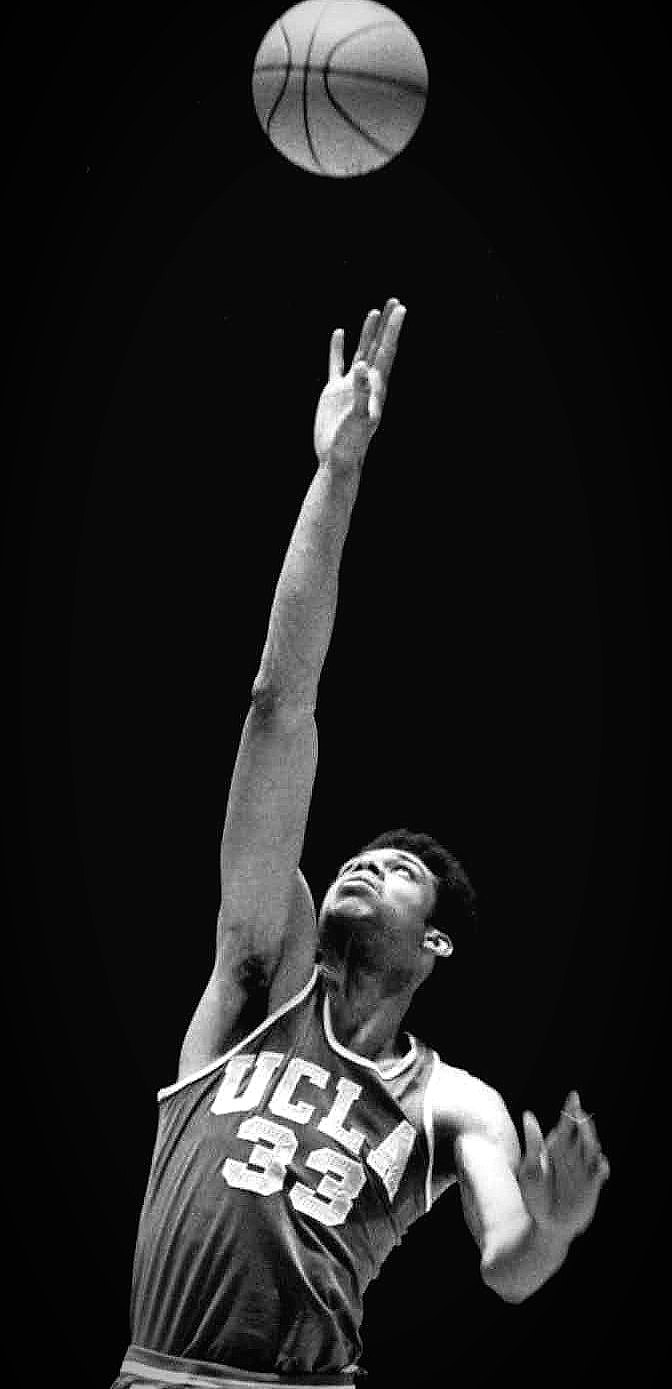
They looked like this: UCLA went 88-2 across his three varsity seasons and won the national championship in 1967, 1968 and 1969. Both losses came in his junior year. The first was to Houston on January 20, 1968, in the Astrodome, in front of 52,693 people, the first regular-season college game broadcast nationally in prime time. Houston won 71-69. Alcindor played it with a scratched left cornea from a game three nights earlier and shot 4-of-18. The rematch came in the national semifinal two months later. UCLA won 101-69, Alcindor had 19 points and 18 rebounds, and Elvin Hayes, who had scored 39 in the Astrodome, was held to 10.
Why did the NCAA ban the dunk?
In April 1967, after Alcindor’s sophomore season, the NCAA outlawed dunking. The rule stayed in force until 1977. Nobody inside the sport pretended it was about anything other than one player, and basketball historians have called it the Alcindor rule ever since, including Abdul-Jabbar himself in Giant Steps.
It worked, in the narrow sense that his scoring average fell each year afterward: 29.0 points a game as a sophomore, 26.2 as a junior, 24.0 as a senior. It failed at everything else. Denied the easiest shot in basketball, he spent the next two years building the hardest one to defend. The skyhook was a right-handed hook released over the left shoulder at the top of a one-legged hop, with his off arm extended into the defender’s chest. At 7 feet 2 with a wingspan to match, the release point was somewhere above eleven feet. There was no legal way to contest it. He used it for the next twenty-two years.
He was a three-time consensus national player of the year, and UCLA hung his jersey in Pauley Pavilion.
The 1969 draft and the ABA’s $3.25 million
Milwaukee, a second-year expansion team, won a coin flip with Phoenix for the first pick and took him. The American Basketball Association’s New York Nets countered with a guaranteed offer of $3.25 million over five years, the largest contract any American team-sport athlete had been offered to that point.
Alcindor asked each league to submit a single sealed bid and said in advance that he would sign with the higher one. Milwaukee’s bid came in at $1.4 million. He signed with the Bucks anyway, on the stated grounds that the ABA was a speculative league whose franchises might not exist in five years. It was the first of several decisions in which he took institutional stability over maximum money, and one of the few he has said, on the record, that he would revisit.
Milwaukee, Oscar Robertson, and the 1971 championship
As a rookie in 1969-70 he averaged 28.8 points and 14.5 rebounds. The Bucks went from 27 wins to 56. He was Rookie of the Year.
In April 1970 Milwaukee traded for Oscar Robertson, then thirty-one and still the most complete perimeter passer in the sport. That solved the one thing the offense lacked. The 1970-71 Bucks finished 66-16, Alcindor won the first of his six MVP awards, Milwaukee went 12-2 through the playoffs, and the Finals against the Baltimore Bullets ended in a four-game sweep. He averaged 27.0 points on 60.5 percent shooting in that series and was named Finals MVP two weeks after his twenty-fourth birthday, the youngest winner of the award to that point. Magic Johnson took that distinction in 1980 at twenty.
He won a second MVP in 1972 and a third in 1974. The 1974 Finals against the Boston Celtics went seven games, and Game 6 produced the shot that most Celtics fans of that generation can still describe: a fifteen-foot skyhook from the right baseline with three seconds left in double overtime at Boston Garden, to win 102-101. Boston took Game 7 in Milwaukee two nights later.
Why did Lew Alcindor change his name?
He began practicing Sunni Islam during his senior year at UCLA, under the guidance of Hamaas Abdul-Khaalis, and took the name Kareem Abdul-Jabbar privately in 1969. Kareem translates roughly as noble or generous; Abdul-Jabbar as servant of the powerful.
He made it public in June 1971, weeks after the championship, at a press conference at the U.S. State Department, standing alongside Robertson and Bucks coach Larry Costello to announce a government-sponsored basketball tour of Africa. He told the reporters in the room that he had been using the name for two years and wanted it used, since he was about to travel abroad representing the country.
He has said in nearly every interview since that he considered it an act of ownership over his own identity rather than a political statement. The reaction, in Milwaukee especially, treated it as the second thing. He writes in Kareem (Random House, 1990) that the mail he received in the weeks afterward was the most hostile of his career.
Why did he leave Milwaukee?
He asked Milwaukee for a trade in October 1974, and the Bucks honored it after the season. The reason he gave publicly was that he did not feel rooted in the city and wanted to live somewhere with a larger Black cultural community. The reason he gave later was more practical: Robertson had retired and the roster was not built to contend again soon. The Bucks sent him to the Los Angeles Lakers on June 16, 1975, for Junior Bridgeman, Dave Meyers, Elmore Smith and Brian Winters.
He won MVP in 1976 and again in 1977. Those Lakers teams were strong in the regular season and carried entirely by his scoring, and without a perimeter creator they went out early three years running. In 1979 Los Angeles used the first overall pick, acquired from New Orleans in a 1976 trade, on Magic Johnson.
Showtime, and five championships in nine years
The Johnson and Abdul-Jabbar Lakers won titles in 1980, 1982, 1985, 1987 and 1988.
The 1980 Finals against the Philadelphia 76ers are remembered for Game 6, when a rookie Magic Johnson started at center in Abdul-Jabbar’s place and scored 42. The game that decided the series was the one before it. Abdul-Jabbar sprained his ankle badly in the third quarter of Game 5, went to the locker room, came back, and finished with 40 points, 15 rebounds and 6 assists. Los Angeles went home up 3-2 and never trailed again.
In 1985, against Boston, he was Finals MVP at 38 years and 54 days, still the oldest winner in the award’s history. He averaged 25.7 points on 60.4 percent shooting in that series, at an age when most centers are retired, and it is usually held up inside the game as the most complete stretch of his late career.
The sixth MVP came in 1980. Nobody else has more than five.
The career scoring record, April 5, 1984
On April 5, 1984, at the Forum in Inglewood, with 8:53 left in the fourth quarter against the Utah Jazz, he shot a skyhook over Mark Eaton from the left block. It was his 31,420th point, one more than Wilt Chamberlain had scored, and it ended a record that had stood since Chamberlain’s retirement in 1973. The game stopped for a ceremony at midcourt.
He held it for 38 years, 10 months and 2 days. James passed him on February 7, 2023, in a Lakers home game against Oklahoma City, with Abdul-Jabbar sitting courtside. James finished the 2025-26 season with 43,440.
The final Abdul-Jabbar line: 38,387 points in 1,560 regular-season games, 24.6 per game, 55.9 percent from the field, 72.1 percent from the line, 17,440 rebounds, 3,189 blocks. He scored 20 or more points a game in seventeen consecutive seasons, from his rookie year through age thirty-eight. He is second all-time in points, minutes played and field goals made, behind James in all three, and fourth in rebounds. The combination of that volume and that efficiency has not been matched by anyone who has played 1,000 games.
Retirement, 1989
He retired after the 1988-89 season at forty-two, at the time the oldest player to appear in an NBA Finals and the oldest to start one. Detroit swept those Finals. He averaged 10.1 points in his final regular season on a team that still reached the Finals, played 74 games, and finished with nineteen All-Star selections, which was the record until James passed it. Naismith Memorial Basketball Hall of Fame, first ballot, 1995.
The second career: books, columns, and the ambassadorship
Abdul-Jabbar has published close to twenty books, most of them nonfiction. Giant Steps (1983) is the definitive source on the Power Memorial and UCLA years. Kareem (1990) covers Los Angeles. Black Profiles in Courage (1996), written with Alan Steinberg, is a history of Black Americans left out of the standard textbooks. On the Shoulders of Giants (2007) is a cultural history of the Harlem Renaissance. Coach Wooden and Me (2017) is a memoir of a fifty-year friendship. He has also co-written three Mycroft Holmes novels with Anna Waterhouse, which are straightforward detective fiction and are not about basketball at all.
He writes a weekly newsletter now. Before that he was a columnist for The Guardian, a contributing editor at Time, and a regular on the Los Angeles Times opinion page. Hillary Clinton named him a United States cultural ambassador in 2012. Barack Obama gave him the Presidential Medal of Freedom in 2016.
He served as a special assistant coach with the Lakers from 2005 to 2011 and briefly with the New York Knicks in 2014. He never got a head-coaching interview that went anywhere, and in a 2015 Washington Post piece on the shortage of Black head coaches he named himself as an example.
Legacy, and the shot that died with him
The standard ranking puts him among the three or four best players the league has produced, with the exact placement depending on how much weight the rubric gives to longevity. Six MVPs. Six championships, with two different cores in two different cities, which nobody since has done. Seventeen straight seasons at 20 points a game. Thirty-eight years and ten months at the top of the scoring list.

The odd part is the shot. Every coach who has tried to teach the skyhook to a younger center, including Abdul-Jabbar during his assistant-coaching years, has reported the same problem: it needs back-to-the-basket comfort, left-hand footwork on a right-handed release, and a willingness to treat it as the first option rather than a counter to something else. The modern game, built on spacing and three-point volume, does not produce players who want all three. So the most efficient high-volume shot in the sport’s history is currently being taken by nobody.
That is a strange fact about a shot that averaged better than twenty points a game for two decades. It is also part of why the record stood as long as it did.
As an Amazon Associate we earn from qualifying purchases.
Related reading
- Los Angeles Lakers franchise history and the Milwaukee Bucks
- Magic Johnson and Oscar Robertson
- NBA all-time scoring leaders
- Every NBA MVP in order
- Wilt Chamberlain, the man whose record he broke
Sources
- Basketball-Reference, Kareem Abdul-Jabbar career page: season-by-season per-game and total splits, career totals, playoff splits (retrieved August 2, 2026)
- Basketball-Reference career leaderboards for points, minutes, field goals, rebounds and blocks (retrieved August 2, 2026)
- Kareem Abdul-Jabbar with Peter Knobler, Giant Steps (Bantam Books, 1983): Power Memorial, the Donohue halftime speech, UCLA, the Alcindor rule
- Kareem Abdul-Jabbar with Mignon McCarthy, Kareem (Random House, 1990): the Lakers years and the reception of the 1971 name change
- National Endowment for the Humanities, “Kareem Abdul-Jabbar Changed the Rules for Black Athletes”: the June 1971 State Department press conference, with Oscar Robertson and Larry Costello, announcing the Africa tour
- NCAA men’s basketball records, 1966-67 through 1968-69: UCLA’s 88-2 varsity record and the 1967 dunk ban
- Naismith Memorial Basketball Hall of Fame, 1995 induction file
- Los Angeles Lakers and Utah Jazz box score, April 5, 1984
- ESPN broadcast and box score, February 7, 2023, Lakers vs Thunder
Shop Jerseys & Fan Gear at Fanatics
As a Fanatics affiliate, we may earn a commission from qualifying purchases.
Shop on Amazon
As an Amazon Associate, we earn from qualifying purchases.
Shop Sneakers & Gear at JD Sports
We may earn a commission from qualifying purchases on JD Sports.
Sources
- Basketball-Reference, Kareem Abdul-Jabbar
- Basketball-Reference, career points leaders
- Naismith Hall of Fame, Kareem Abdul-Jabbar
- UCLA Athletics, men's basketball championship history
- Kareem Abdul-Jabbar and Peter Knobler, "Giant Steps" (Bantam, 1983)
- Kareem Abdul-Jabbar, "Kareem" (Random House, 1990)
- National Endowment for the Humanities, "Kareem Abdul-Jabbar Changed the Rules for Black Athletes"