Stephen Curry
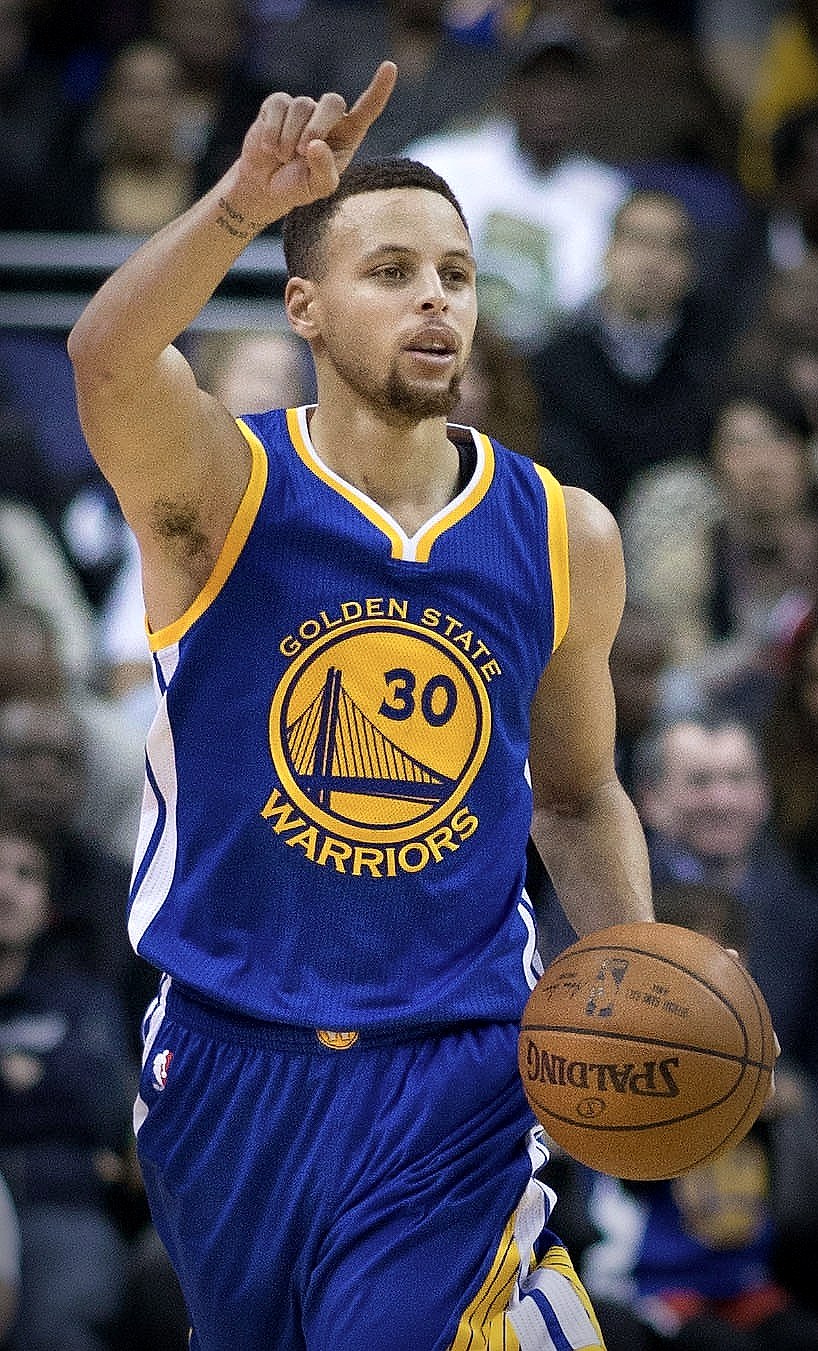
Stephen Curry is the NBA’s career three-point leader with 4,248 made threes through the 2025-26 season, a four-time champion with the Golden State Warriors, a two-time regular-season Most Valuable Player, and the only player ever to win that award by a unanimous vote. He has played all seventeen of his NBA seasons in one uniform.
That is the résumé, and it has been recited often enough. The more useful sentence is this one: no guard in the history of the sport has changed what coaching staffs at every level draw up on a whiteboard as much as he has, and the change is still working its way down through the game.
Akron, Charlotte, and a father who shot 40 percent from three
Curry was born on March 14, 1988, in Akron, Ohio, while his father Dell was finishing a rookie season with the Cleveland Cavaliers. The family moved to Charlotte later that year when Dell was taken by the expansion Hornets, and Stephen grew up inside an NBA building. He did homework in the family room at Charlotte Coliseum. He shot in the layup line during warmups. He watched his father make 40.2 percent of his career three-point attempts across sixteen seasons, which in the early 1990s put Dell Curry near the top of the league at a skill nobody yet treated as a foundation.
Shop Stephen Curry jersey
As an Amazon Associate we earn from qualifying purchases.
He played at Charlotte Christian, finished his senior year listed at around 6 feet and 160 pounds, and drew no serious ACC interest. Virginia Tech, where Dell had been an All-American, declined to offer a scholarship and suggested he walk on. The stated reason at the time was size. Bob McKillop at Davidson, a Southern Conference program forty minutes up the road, offered anyway and signed him in the fall of 2005.
What actually happened at Davidson in 2008?
Curry started as a freshman and made All-Southern Conference. Then came March 2008, which is the four-game stretch that put him in the lottery.
Davidson entered the tournament as a 10 seed. Curry scored 40 against Gonzaga in the first round on 8-of-10 shooting from three. He scored 30 against second-seeded Georgetown, 25 of them after halftime, in a comeback from seventeen down. He scored 33 against third-seeded Wisconsin. Then Davidson lost 59-57 to eventual national champion Kansas in the Elite Eight, with Curry double-teamed on the final possession and the last shot going to point guard Jason Richards, who missed a three at the buzzer.
Across those four games he averaged 32.0 points. He led the entire 2008 tournament in points per game, in three-pointers made with 23, and in steals per game at 3.25. He came back for his junior season, moved to point guard, averaged 28.6 points, and entered the 2009 draft as the consensus best shooter in the class.

The 2009 draft, the ankle years, and a contract that got underpaid
Minnesota, picking fifth and sixth, took Ricky Rubio and then Jonny Flynn. Golden State took Curry seventh. The Warriors at that point were not a franchise anyone expected to contend, and his first three seasons produced records of 26-56, 36-46, and 23-43.
The second and third of those years were the ankle years. A series of right-ankle sprains cost him most of 2011-12, when he played 26 games, and produced surgeries in May 2011 and April 2012. Golden State signed him to a four-year, $44 million extension in October 2012 anyway. Given the ankle record, the deal was read at the time as a real gamble on a body that might not hold. It became one of the most undervalued contracts in league history and a recurring reference point for Curry in every later conversation about player pay.
The 2012-13 team, with a rookie Harrison Barnes and a second-year Klay Thompson, went 47-35 and reached the second round. Curry averaged 22.9 points and made 272 threes. The ankle held.
What did Klay Thompson actually change?
The Splash Brothers label started as a nickname for a two-guard backcourt that could both shoot. What it described in practice was a spacing problem no defense had faced before.
Guarding Curry off a screen requires a hard hedge or a switch. Both create a moment of scramble. Against most teams, that scramble is survivable, because the recovering defender only has to reach a player who needs a dribble and a rhythm step to get a shot off. Thompson needed neither. He was the best catch-and-shoot player of his generation and the rare star who never asked for the ball, which meant he punished the scramble without complicating the offense.
Thompson made 2,899 career three-pointers, fourth on the all-time list. He and Curry were teammates from 2011 through 2024 and won four championships together. Thompson’s 2019 ACL tear in Game 6 of the Finals, followed by a torn Achilles in November 2020, cost him two full seasons and is the single biggest reason the Warriors’ dynasty has a gap in the middle of it.
Steve Kerr, the first MVP, and the 2015 title
Kerr was hired in May 2014 to replace Mark Jackson. He imported the motion-heavy off-ball offense he had played inside in Chicago and San Antonio, and, more consequentially, he ran Curry through ball screens at a volume no previous Warriors guard had been given.
Curry won the 2015 MVP. Golden State went 67-15 and beat the Cleveland Cavaliers in six games in the Finals. Andre Iguodala took Finals MVP, a vote that rewarded his defense on LeBron James. The honest version, which Kerr has said out loud since, is that Curry had the worst shooting series of his career to that point against a Cleveland defense that funneled him toward Timofey Mozgov at the rim.
73-9, the unanimous MVP, and the collapse
The 2015-16 season was the best and the worst one. The Warriors went 73-9, breaking the 1995-96 Chicago Bulls’ record of 72 wins. Curry averaged 30.1 points, shot 45.4 percent from three on 11.2 attempts a game, and was named MVP on a unanimous ballot, still the only unanimous vote in the history of the award.
He made 402 three-pointers that season. The previous record was his own 286, set the year before. Nobody has come within 40 of 402 since, including him; his second-best season is 357, in 2023-24. The signature shot of the year came on February 27, 2016, in Oklahoma City: a pull-up from near the Thunder logo, off the dribble, over Russell Westbrook, with 0.6 seconds left in overtime.
The Finals went seven games and Cleveland came back from 3-1 down. Draymond Green was suspended for Game 5. Curry was playing on a knee he had sprained in the first round against Houston. He fouled out of Game 6 for the first time in his NBA career and threw his mouthpiece into the stands. LeBron James produced the most complete individual Finals of the modern era, and the two possessions everyone remembers, the chase-down block on Iguodala and Kyrie Irving’s three over Curry with 53 seconds left, both closed against him. He still calls that series the reference point.
Kevin Durant, 2017 and 2018
Golden State signed Kevin Durant in July 2016, made possible by the salary-cap jump that came with a new national television deal. They won in 2017 over Cleveland in five games and in 2018 over Cleveland in four, going 16-1 and 16-5 through those two postseasons. Durant was Finals MVP both years.
How much those two titles count toward Curry’s individual case has been a cable-television argument ever since. The point Curry has made in response is narrow and defensible: his scoring went down in those Finals because it did not need to go up, and the ring count is the number that compounds.
The 2019 Finals against Toronto ended the first phase. Durant tore his Achilles in Game 5, Thompson tore his ACL in Game 6, and the Raptors won in six. Curry averaged 30.5 points in that series against a defense that rotated Kawhi Leonard and Fred VanVleet at him and had no answer for either.
The recovery years and the 2022 championship
The 2019-20 season disappeared. Curry broke his left hand in October and played five games. The 2020-21 team lost in the play-in. He averaged 32.0 points that year, the highest of his career, and won the scoring title at thirty-two years old on a roster that missed the postseason.
The 2021-22 Warriors, with Andrew Wiggins, a returning Thompson and a rookie Jonathan Kuminga, went 53-29 and beat the Boston Celtics in six games in the Finals. Curry averaged 31.2 points, 6.0 rebounds and 5.0 assists in that series while shooting 43.7 percent from three against the league’s best defense. He was Finals MVP, the one piece of hardware that had been missing. After Game 6 in Boston he cried on the floor and held up four fingers to the camera.
The career three-point record
On December 14, 2021, at Madison Square Garden, in the first quarter of a game against the New York Knicks, Curry hit his 2,974th career three-pointer and passed Ray Allen. Allen and Reggie Miller, the two men he had just moved ahead of, were both in the building. Play stopped.
Where the list stands now is worth stating plainly, because the margin is the story. Curry has 4,248. James Harden is second with 3,390. Allen is third with 2,973, Klay Thompson fourth with 2,899. Curry is also the single-season record holder at 402, the playoff career leader with 650, and the holder of the NBA Finals single-game record with nine, set in Game 2 of the 2018 Finals against Cleveland.
Paris 2024
Curry turned down Olympic selection in 2016 and 2020 for rest and family reasons, so his entire international career is one tournament. He accepted the 2024 invitation at thirty-six.
In the semifinal against Serbia, with the United States down by as many as seventeen, he scored 36 and made nine of fourteen from three. In the final against France he scored 24 and made eight threes, four of them inside the last three minutes, including a stepback over Nicolas Batum with the shot clock at one that he has since called the best shot of his career. The United States won 98-87. He scored 60 points in the last two games of the only major international tournament he ever played.
Under Armour, and the deal Nike let go
Nike had signed Curry out of Davidson and let the contract lapse during the 2013 restricted-free-agent window. The pitch meeting that summer has been reported in detail, including a slide deck that carried another player’s name and a mispronunciation of Curry’s first name in the room. Under Armour signed him in the fall of 2013 for a fraction of what Nike would have had to match.
By 2015 he was the entire basketball line. The signature series began with the Curry One in 2015 and has run continuously since; the Curry 4 FloTro reissue in 2022 was the fastest-selling basketball shoe Under Armour had released. On December 1, 2020, Under Armour launched Curry Brand as a standalone label, with footwear reaching stores on December 11. The structure follows the Nike and Jordan Brand split of 1997, and the commercial scale does not come close; nothing does. What it did was build a second asset at a moment when Under Armour’s other basketball signings had gone quiet, and give Curry a position in the business of his own image that players a generation earlier were never offered.
Shop Curry Under Armour at JD Sports →
Where does the career stand after 2025-26?
The 2025-26 season was the hardest of the late run. Curry played 43 games, missing 39 with what the team eventually described as runner’s knee, and Golden State lost in the play-in and missed the playoffs. He averaged 26.6 points and shot 39.3 percent from three in the games he played, which at thirty-seven is not a decline curve so much as an availability problem.
The career line through seventeen seasons: 1,069 games, 26,528 points, 24.8 points per game, 42.2 percent from three, 91.2 percent from the free-throw line. In the postseason he has played 155 games and averaged 26.8 points. He is the franchise’s all-time leader in essentially every offensive category that exists.
Legacy, and the structural argument
The standard case for Curry as a top-ten player runs on four championships, two MVPs and the three-point record. The standard counter-case, heard less than it was five years ago, points at his defense, his size, and the rosters around him.
Neither argument is the interesting one. The interesting one is arithmetic. A pull-up three off the dribble, taken from four feet behind the line by a player who makes better than 42 percent of them, is worth about 1.27 points per attempt. There is no two-point shot outside the restricted area that comes close. Once one player could do that reliably, every defense in the league had to pick him up eight to twelve feet earlier, and picking him up earlier opened the floor for everybody else on the court.
League-wide, 22.2 percent of shots were three-pointers in Curry’s rookie year of 2009-10. By 2023-24 the figure was 42.4 percent. That shift is not his alone, and the people who ran the numbers first were front-office analysts, not shooters. But the analysts had been publishing the same math since the 1990s and nobody moved, because the shot they were describing did not exist yet in a form a coach could build around. Curry made it exist.
Marcus Thompson II’s Golden: The Miraculous Rise of Steph Curry (Touchstone, 2017) is still the best reported account of the Davidson years through the first title. The championship count is four, the MVP count is two, the Finals MVP is one, and the record will keep moving as long as he is upright and on a roster. The part that outlasts all of it is the rubric change: for a hundred years the best available shot was the one closest to the rim, and now it is the one that pulls the defense furthest from it.
As an Amazon Associate we earn from qualifying purchases.
Related reading
- Golden State Warriors franchise history
- Klay Thompson and Draymond Green
- The history of the three-point line
- Every NBA MVP in order
- Most NBA championship rings
Sources
- Basketball-Reference, Stephen Curry career page: per-game and total splits through 2025-26, playoff splits, 2022 Finals series line (retrieved August 2, 2026)
- Basketball-Reference, career three-pointers made leaderboard (Curry 4,248; Harden 3,390; Allen 2,973; Thompson 2,899), retrieved August 2, 2026
- NCAA.com, retrospective on Davidson’s 2008 tournament run: 40, 30, 33 and 25 points, 32.0 per game, 23 threes, 3.25 steals per game
- NBA Communications, May 10, 2016 announcement of the unanimous MVP vote
- ESPN game recap, December 14, 2021, Warriors at Knicks, career three-point record
- Olympics.com and Team USA tournament reports, August 8 and 10, 2024, Paris Olympic semifinal and final
- Under Armour press release, December 1, 2020, Curry Brand launch
- NBC Sports Bay Area reporting on the 2025-26 season, runner’s knee diagnosis and games missed
Shop Jerseys & Fan Gear at Fanatics
As a Fanatics affiliate, we may earn a commission from qualifying purchases.
Shop on Amazon
As an Amazon Associate, we earn from qualifying purchases.
Shop Sneakers & Gear at JD Sports
We may earn a commission from qualifying purchases on JD Sports.
Sources
- Basketball-Reference, Stephen Curry
- Basketball-Reference, career three-pointers made leaders
- Basketball-Reference, 2022 NBA Finals, Celtics vs Warriors
- NCAA, Steph Curry and the Davidson 2008 tournament run
- Golden State Warriors, official site
- Under Armour, Curry Brand launch announcement, December 1 2020
- Olympics.com, Paris 2024 men's basketball final report